
Nasun devnet launched on March 4, 2026. Two founders, no external funding, built entirely on personal capital and backed by ten grants and pitch contest wins from Korean government agencies. Pado, our DeFi and gaming platform, followed on April 9. Here is what 40 days of data looks like, what we are building, and why it matters for this space.
The Numbers
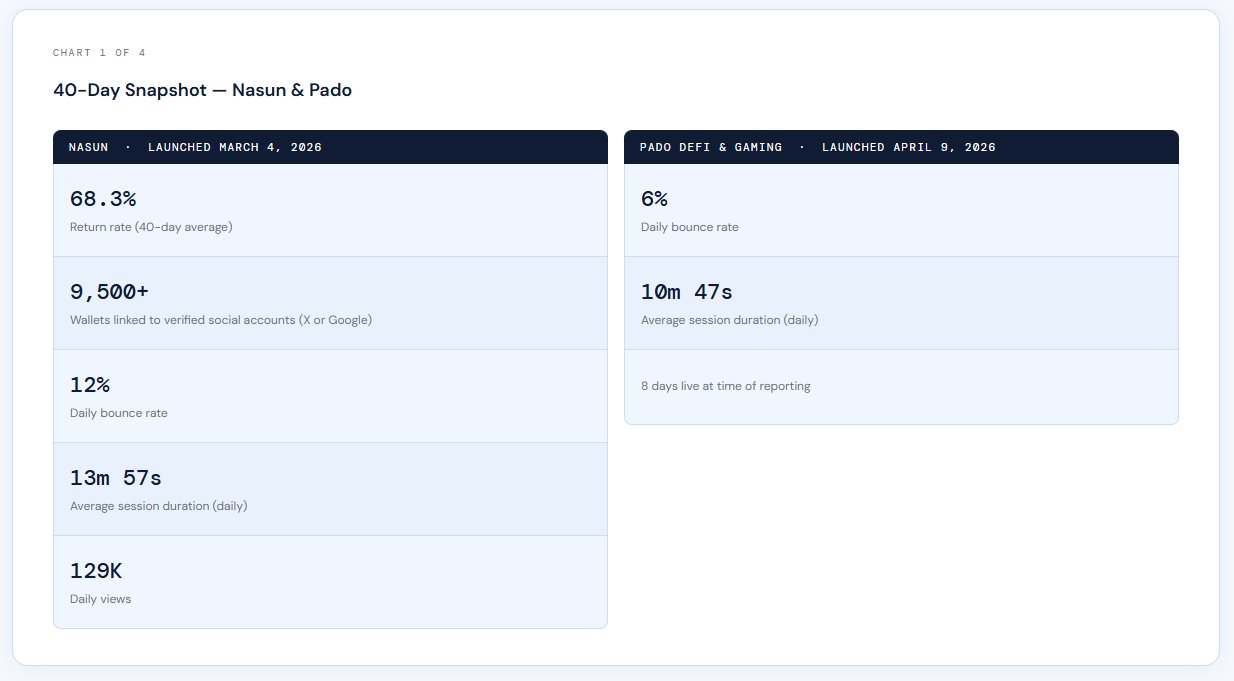
What These Numbers Mean
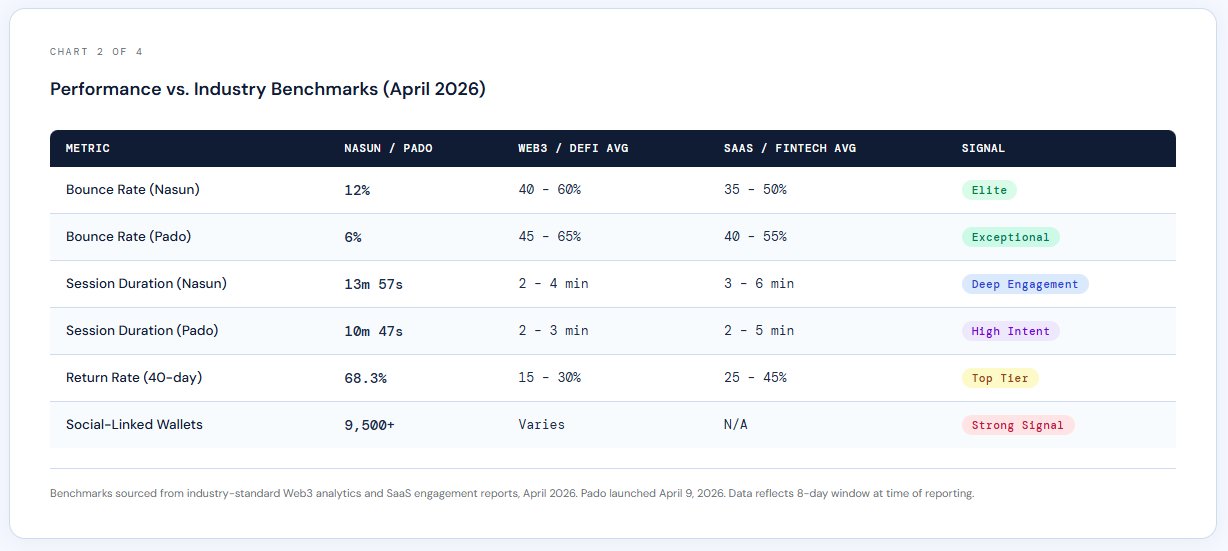
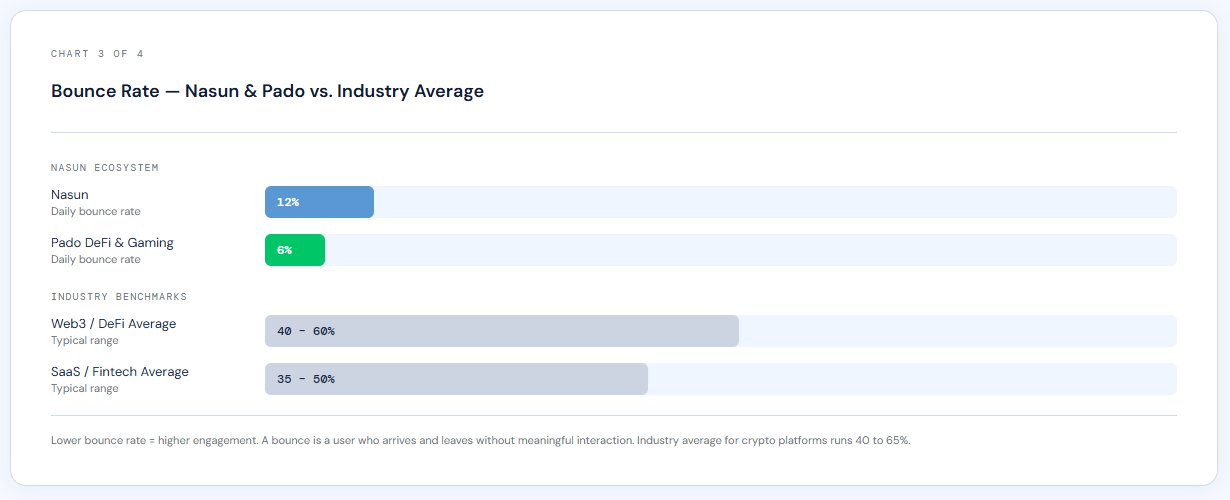
Bounce rate. The industry average for Web3 and DeFi platforms sits between 45 and 60%. A bounce is a user who arrives and leaves without meaningful interaction. The lower the number, the more users are staying and exploring. Nasun is running at 12%. Pado, eight days after launch, is at 6%. Bots interacting with smart contracts do not touch the frontend and do not register in this data at all. What the bounce rate captures is purely human navigation behavior. At 6%, users are arriving and moving through the product. That number reflects the frontend experience on its own terms, with no noise from automated contract activity.
Session duration. The Web3 average sits between 1 minute 50 seconds and 2 minutes 15 seconds. Nasun users are averaging 13 minutes 57 seconds. Pado users are averaging 10 minutes 47 seconds. Session duration at this level indicates that users are not completing a single action and closing the tab. They are navigating, exploring, and staying. That depth of engagement is what separates a product from a campaign.
40-day return rate. Most Web3 projects see significant drop-off after the first week. Early-stage DeFi protocols at equivalent stages, including projects that later became category leaders, typically saw 20 to 30% return rates in their testnet phases. Web3 games, which have some of the strongest retention mechanics in the space, target 40% at Day 30. Nasun’s 40-day average return rate is 68.3%. That figure is not a snapshot. It is an average across the full 40-day window, meaning users came back repeatedly, not once.
Social-linked wallets. 9,500 wallets are connected to verified X or Google accounts. In a space where wallet farming and Sybil activity inflate user counts routinely, identity-linked wallets represent a materially different signal. These are users who connected a real social identity to their on-chain activity. That reduces noise in the data and represents a genuine onboarding success in an environment where most projects struggle to get users past anonymous wallet creation.
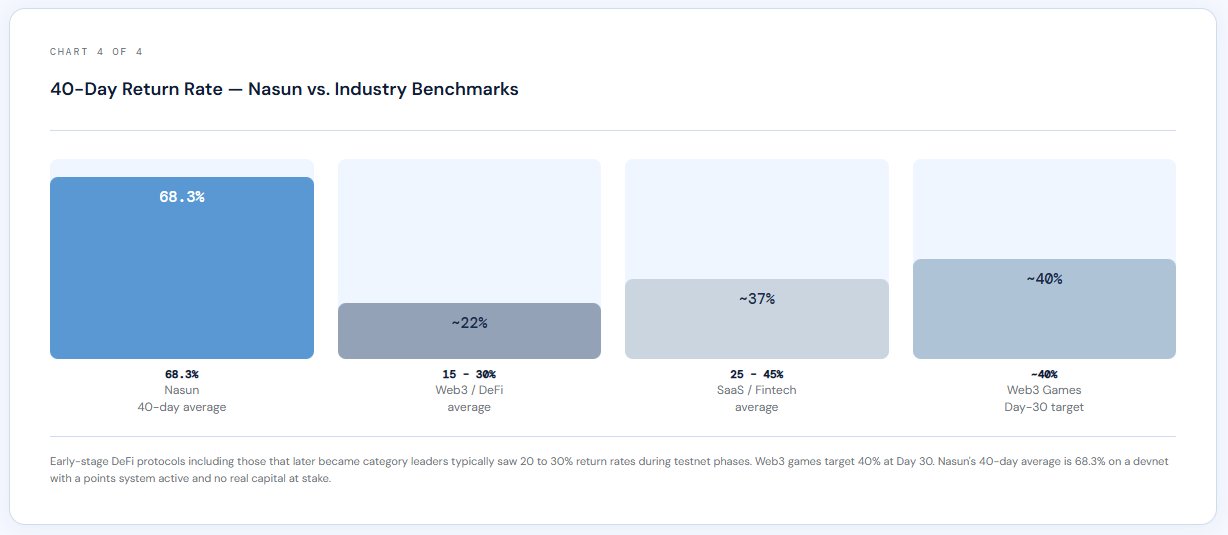
A point system is running and users are completing daily missions to earn points. That context matters. What the data shows is that engagement goes well beyond the minimum required to farm points. Session durations of 10 to 14 minutes and return rates of 68% over 40 days are not explained by a points system alone. The behavioral baseline being observed is what the incentive layers will build on when competitive leaderboards and real capital enter the picture.
Why Crypto and Web3 Have an Adoption Problem
The problems are not new. Ecosystems are fragmented, projects are siloed from each other and from users, and the UX barrier is real: seed phrases, bridges, wallets, gas fees, and the cognitive weight of navigating disconnected products that share nothing with each other. Incentive structures are misaligned. Protocols optimize for TVL. Projects optimize for token price. Users sit in the middle as the extractable resource rather than the participants the entire system depends on.
Hundreds of millions of people have touched crypto and walked away. The technology did not fail them. The experience did.
These are not new observations. What has been missing is a product that addresses all three simultaneously rather than solving one and ignoring the others.
A Different Starting Point
Naru is a clinical psychologist with peer-reviewed research on social media behavior and online engagement, and spent a decade in the South Korean film industry as an editor and producer, leading cast and crews from preproduction through theatrical release, with work premiering at Cannes, Berlin, and Venice.
Overclocked spent twenty years as a film director and head of graphics on national television ad campaigns for Microsoft, Nike, and IBM, built a sci-fi multiplayer shooter in Unreal Engine with C++, and has been in crypto since 2017 as a moderator, DAO builder, and developer. He has also owned two restaurants and a 5,000 square foot gourmet market in NYC managing over a hundred employees.
Neither of us came from finance or infrastructure engineering. We came from a foundational question: why do people engage, what makes an experience worth returning to, and what does it feel like to be inside a product that treats you as a participant rather than a metric.
That is not a philosophical position. It is an architectural one. Every mechanic in Nasun, the daily mission structure, the health system, the reputation layer, the way projects access users, the way commerce operates, follows directly from taking that question seriously at the design level.
We are approaching this space and its problems from a fundamentally different perspective. We are looking deeply into the behaviors and desires of all participants, giving ourselves to be creative in our approach, then executing with precision. Our professional backgrounds in delivering high quality products for mass consumption have shaped how we work. The proof is in the experience and the numbers.
We also build fast. We have been creators our whole lives, working at the highest professional level, intense, goal-driven and demanding. Ten government grants from Korean national agencies in two years. A working L1, a behavioral hub, and a DeFi and gaming platform, all on personal capital. We are not waiting for permission from this industry to build what it needs.
What We Are Solving
Fragmentation means users start over with every app. Identity, history, and reputation reset to zero each time. We are building a unified hub where everything a user does across every app and service they activate compounds into a single record that belongs to them. Nothing resets.
UX friction has kept most people who are curious about crypto from staying. zkLogin means entry with a Google or X account. No seed phrase. No wallet setup. No prior crypto knowledge required. The experience has to be as accessible as anything people already use daily.
Misaligned incentives mean the people who build a community capture the least value from it. We are building a system where users, projects, services, advertisers, validators, and token holders all have their interests accounted for separately while having a net benefit for the entire ecosystem. Not because of ideology but because the architecture makes mutual growth the most rational outcome for every participant.
The longer vision is for the Nasun ecosystem to be open to any project from any chain. Move-native projects are the immediate focus. The architecture is built to extend to Solana, EVM, and beyond. The goal is for Nasun to function as the hub of crypto and Web3, a shared identity and distribution layer that any project can integrate with and any user can access from one place.
This is the original promise of Web3. Ownership, participation, an internet that works for the people inside it. That promise got buried under extraction and institutional capture. We are not making a political argument. We are building the product.
What Is Coming
We will now be focusing on our line of products and deepening our relationship with the community while reaching out to others in order to keep growing.
Private testing of Pado’s prediction markets begins shortly. A social app addressing what Web3 social has consistently failed to deliver is in development. More games are coming to Pado. Baram, our AI governance layer, and SPECTRA, our multiplayer shooter, are moving toward private testing. The website is being updated. And the centerpiece of the entire ecosystem, the hub that ties everything together, is getting a full rebrand and a major upgrade that changes how the whole experience feels and operates.
We will also be releasing our litepaper soon.
We are building in public, sharing real numbers, and moving fast because that is what we do.
Nasun is a long play for people who understand what we are building and want to be part of it. If you are here asking when TGE is and when you can flip the NFTs, this is not the project for you. We are looking for people who understand the problems blocking adoption in this space and the scale of work required to solve them. We want long-term partners who want to help build Nasun into a premier ecosystem next cycle.
The community that has been here for 40 days already knows this. This is for everyone who has not found us yet.
Article link: https://x.com/Nasun_io/status/2044988473762042123?s=20